
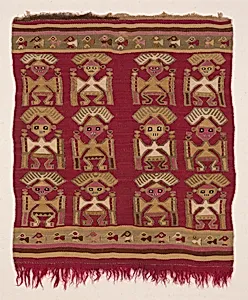
Fragment (Loincloth)
1250-1470
Medium
Cotton and wool (camelid), slit tapestry weave; edged with plain weave extended weft cut fringe
Dimensions
50.8 × 41 cm (20 × 16 1/8 in.)
Classification
costume - weaving
Department
Textiles
Museum
Art Institute of Chicago
Accession Number
85434
Rights
Public Domain
About this artwork
Following the decline of their ancestors, the Moche, the Chimú emerged as one of the most powerful cultures of South America, dominating several rich valleys across the north coast of Peru for more than five centuries, from around A.D. 900 to 1465. Chimú weavers created strikingly graphic designs through the repetition of simple, abstract forms in vivid color combinations—particularly red, white, and yellow—against a solid background. Most of these textiles depict an anthropomorphic male figure ...
About the Artist
Chimú
The Chimú, a preeminent pre-Columbian culture of Peru's northern coast, flourished from approximately 900 to 1470 CE as the Kingdom of Chimor, emerging in the wake of the Moche civilization's decline and incorporating influences from the Sican, Wari, and Cajamarca cultures. Centered in the vast adobe metropolis of Chan Chan—the largest city in the Americas before the Inca, housing up to 60,000 peo...