
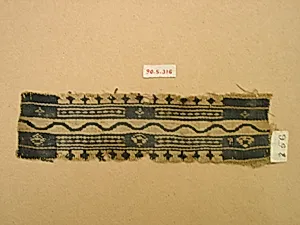
Fragment of a Band
Unknown Artist
4th–5th century
Medium
Wool, linen; plain weave, tapestry weave
Dimensions
Max. H. 2 in. (5.1 cm) Max. W. 7 1/4 in. (18.4 cm)
Classification
Textiles
Department
Islamic Art
Museum
Metropolitan Museum of Art, New York, NY
Credit
Gift of George F. Baker, 1890
Accession Number
90.5.316
Rights
Public Domain
Art Historical Context
This delicate *Fragment of a Band*, dating to the 4th–5th century, offers a rare glimpse into the sophisticated textile traditions of the early medieval Near East or North Africa, now housed in the Metropolitan Museum of Art's Department of Islamic Art. Measuring just 2 inches high and 7¼ inches wide, this wool and linen piece was generously gifted by George F. Baker in 1890. Such small survivals from antiquity are treasures, as organic materials like textiles rarely endure the ages. Crafted using plain weave for the foundation and tapestry weave for vibrant decoration, the fragment highlights masterful techniques that allowed weavers to create intricate patterns with colored yarns. Tapestry weave, where weft threads completely cover the warp, produced durable, pictorial bands ideal for trimming garments, curtains, or mummy wrappings—common in regions like Coptic Egypt. Though the artist remains unknown, this artifact underscores the cultural crossroads of late antiquity, bridging pre-Islamic and emerging Islamic worlds. It reveals everyday artistry, trade in dyes and fibers, and the skill of anonymous craftspeople whose work adorned daily life, inviting us to appreciate the unsung beauty of ancient fabrics.