
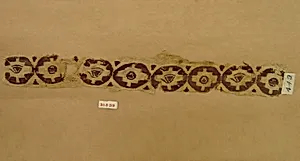
Fragment of a Band
Unknown Artist
3rd–4th century
Medium
Wool, linen; plain weave, tapestry weave
Dimensions
Max. H. 13 1/4 in. (33.7 cm) Max. W. 1 3/4 in. (4.4 cm)
Classification
Textiles
Department
Islamic Art
Museum
Metropolitan Museum of Art, New York, NY
Credit
Gift of George F. Baker, 1890
Accession Number
90.5.319
Rights
Public Domain
Art Historical Context
This delicate *Fragment of a Band*, dating to the 3rd–4th century, offers a glimpse into the sophisticated textile traditions of late antiquity. Housed in the Metropolitan Museum of Art's Department of Islamic Art, this narrow wool and linen strip—measuring just 13¼ inches high and 1¾ inches wide—was likely part of a larger garment, furnishing, or ceremonial object from the Near East or Egypt, regions where such woven bands decorated edges and borders. Though the artist remains unknown, its survival as a rare artifact speaks to the enduring craftsmanship of the era, preserved through arid burial conditions or careful reuse. Crafted using plain weave for the sturdy ground and tapestry weave for colorful motifs, the band exemplifies early weaving techniques that allowed intricate patterns without complex looms. Wool provided durability and vibrant dyes, while linen added a crisp texture—materials traded widely along ancient Silk Road routes. These methods foreshadowed the opulent textiles of later Islamic cultures, highlighting continuity in artistic production. Gifted to the Met in 1890 by George F. Baker, this fragment invites us to imagine the hands that wove it: skilled artisans whose work adorned daily life and rituals, bridging pre-Islamic antiquity to the rich tapestry traditions we celebrate today.