
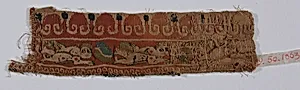
Fragment of a Band
Unknown Artist
5th–6th century
Medium
Linen, wool; tapestry weave
Dimensions
H. 7 3/8 in. (18.7 cm) W. 3/4 in. (1.9 cm)
Classification
Textiles
Department
Islamic Art
Museum
Metropolitan Museum of Art, New York, NY
Credit
Rogers Fund, 1909
Accession Number
09.50.1063
Rights
Public Domain
Tags
Art Historical Context
This delicate *Fragment of a Band*, to the 5th–6th century, offers a glimpse into the sophisticated textile arts of the early medieval Near East. Crafted from and wool in a tapestry weave—a labor-intensive technique where colorful weft threads fully cover the warp yarns, creating a vibrant, durable pictorial surface—this narrow strip (just 7⅜ inches high and ¾ inch wide) likely served as decorative trim for garments, furnishings, or ceremonial objects. Its preservation highlights the skill of ancient weavers, who produced such intricate pieces despite the fragility of organic materials. Housed in the Metropolitan Museum of Art's Department of Islamic Art (acquired through the Rogers Fund in 1909), the fragment reflects the cultural crossroads of late antiquity, bridging pre-Islamic traditions with emerging Islamic aesthetics. Mythical creatures, hinted at by its motifs, were popular symbols in textiles from regions like Egypt or the Levant, evoking protection, power, or otherworldly realms. These designs drew from diverse influences, including Sassanian Persia and Coptic Christianity, underscoring textiles' role in storytelling and status. Though small, this artifact reveals the artistry of anonymous makers whose woven wonders adorned daily life and rituals, surviving centuries to connect us with a vibrant, myth-filled past.