
Textile Fragment
Unknown Artist
4th century
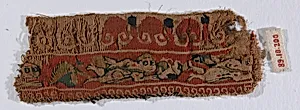
Medium
Wool, linen; plain weave, tapestry weave
Dimensions
H. 6 1/8 in. (15.6 cm) W. 1 3/4 in. (4.5 cm)
Classification
Textiles
Department
Islamic Art
Museum
Metropolitan Museum of Art, New York, NY
Credit
Purchase by subscription, 1889
Accession Number
89.18.200
Rights
Public Domain
Art Historical Context
This delicate textile fragment, dating to the 4th, offers a rare glimpse into the sophisticated weaving traditions of the ancient Near East or Egypt. Crafted from wool and linen using plain weave for the foundation and weave for ornamental details, it measures just 6 1/8 by 1 3/4 inches—small enough to have adorned a garment edge, belt, or furnishing. Acquired by the Metropolitan Museum of Art in 1889 through a subscriber purchase, it resides in the Islamic Art department highlighting the continuity of textile arts across pre-Islamic and early Islamic eras. The dual weaving techniques showcase remarkable skill: plain weave provided sturdy, everyday durability, while tapestry weave allowed weavers to create vibrant, pictorial motifs by interweaving colored wefts to fully cover the warps. Such methods were labor-intensive, often produced in workshops for trade along Silk Road routes, reflecting cultural exchanges between Roman, Byzantine, and local traditions. As a humble survivor from antiquity, this fragment underscores textiles' vital role in daily life and ritual, preserving colors and patterns that paintings or sculptures rarely capture. In the Met's collection, it connects visitors to the ingenuity of anonymous artisans whose work laid the groundwork for later Islamic opulence in fabrics.