
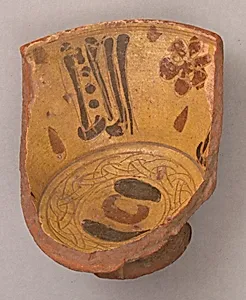
Fragment of a Bowl
Unknown Artist
14th–15th century
Medium
Earthenware; incised decoration through a white slip and coloring under transparent glaze
Dimensions
H. 4 1/8 in. (10.5 cm) W. 5 3/4 in. (14.6 cm) D. 6 5/8 in. (16.8 cm) Wt. 16 oz. (453.6 g)
Classification
Ceramics
Department
Islamic Art
Museum
Metropolitan Museum of Art, New York, NY
Credit
Rogers Fund, 1907
Accession Number
07.238.5
Rights
Public Domain
Art Historical Context
This delicate fragment of a bowl, dating to the 14th–15th century, offers a glimpse into the refined world of Islamic ceramics. Crafted from earthenware in the Metropolitan Museum of Art's Islamic collection, it exemplifies the technical mastery of potters from the medieval Islamic world, where everyday vessels doubled as canvases for artistic expression. Acquired through the Rogers Fund in 7, this piece measures just over 4 inches high and a substantial 16 ounces, hint at its original robustness despite being only a partial survivor. The bowl's standout feature is its incised decoration, created by scratching through a white slip layer to reveal the reddish body beneath, followed by colored accents and a transparent glaze. This sgraffito technique—known as *champlevé* in some traditions—produced vibrant contrasts and intricate patterns, blending functionality with beauty. Such methods flourished across regions like Persia, Syria, and Egypt during this era, reflecting cultural exchanges along trade routes like the Silk Road. Though incomplete, the fragment evokes the opulence of Islamic tableware, where pottery bridged art and daily life. Visitors, imagine sipping from a full bowl like this—its glossy surface catching the light amid bustling bazaars!