
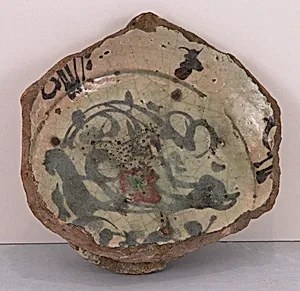
Fragment of a Bowl
Unknown Artist
13th century
Medium
Earthenware; underglaze painted
Dimensions
Max. H. 1 3/4 in. (4.4 cm) Max. W. 5 in. (12.7 cm
Classification
Ceramics
Department
Islamic Art
Museum
Metropolitan Museum of Art, New York, NY
Credit
Rogers Fund, 1907
Accession Number
07.238.29
Rights
Public Domain
Art Historical Context
This delicate fragment of a bowl, crafted in the 13th century, offers a glimpse into the refined world of Islamic ceramics. Made from earthenware and adorned with underglaze painting technique where pigments are applied to the unfired clay body before a transparent glaze is added—this small piece (just 1¾ inches high and 5 inches) survives as a testament to everyday artistry in the medieval Islamic world. Likely part of a larger vessel used for food or water, its fragmented state highlights the fragility of such objects over centuries. Underglaze painting emerged as a hallmark innovation in 13th-century Islamic pottery workshops, particularly in regions like Persia (modern Iran) and Syria. This method produced vibrant, durable designs that withstood daily use, often featuring intricate geometric patterns, floral motifs, or calligraphy inspired by nature and Islamic aesthetics. Unlike earlier lead glazes prone to cracking, underglaze allowed for bolder colors and finer details, elevating ceramics from utilitarian ware to coveted art. Acquired by The Metropolitan Museum of Art through the Rogers Fund in 1907, this fragment exemplifies the cultural flourishing of Islamic art during the Mongol era's disruptions and innovations. It invites us to imagine bustling markets where such bowls brought beauty to ordinary life, underscoring pottery's role in preserving artistic traditions across the vast Islamic domains.