
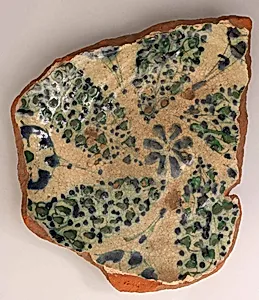
Fragment of a Bowl
Unknown Artist
15th century
Medium
reddish earthenware; white slip; green underglaze; transparent colorless glaze
Classification
Ceramics
Department
Islamic Art
Museum
Metropolitan Museum of Art, New York, NY
Credit
Rogers Fund, 1908
Accession Number
08.184.31
Rights
Public Domain
Art Historical Context
This exquisite fragment of a bowl, dating to the 15th, hails from the rich tradition of Islamic ceramics, likely produced in regions like Iran or Syria where pottery flourished under Timurid or Ottoman influences. Though only a portion survives, it offers a glimpse into the sophisticated craftsmanship of the era, when potters created vessels for both daily use and elite patronage, blending functionality with stunning visual appeal. Crafted from reddish earthenware—a durable, locally sourced clay common in Islamic pottery—the fragment features a white slip base for a smooth canvas, vibrant green underglaze for decoration, and a transparent colorless glaze that seals and enhances the colors with a luminous sheen. These techniques highlight the ingenuity of Islamic artisans, who mastered underglaze painting to achieve jewel-like hues without the fragility of glass or metal. Green tones, evoking lush gardens and paradise motifs from Islamic art, were especially prized. Acquired through the Rogers Fund in 1908, this piece now graces the Metropolitan Museum of Art's Islamic Art department, reminding us of the interconnected Silk Road world where such ceramics inspired global tastes in decorative arts. A testament to enduring beauty, even in fragments.