
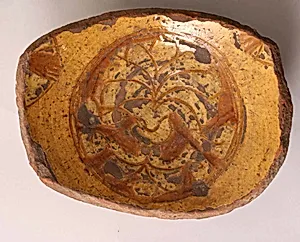
Fragment of a Bowl
Unknown Artist
14th–15th century
Medium
Earthenware; incised decoration through white slip and coloring under transparent glaze
Classification
Ceramics
Department
Islamic Art
Museum
Metropolitan Museum of Art, New York, NY
Credit
Rogers Fund, 1913
Accession Number
13.190.166
Rights
Public Domain
Art Historical Context
This exquisite fragment of a bowl, dating to the 14th–15th century, offers a glimpse into the vibrant of Islamic ceramics. Crafted from earthenware in the Islamic Art tradition, it exemplifies the technical mastery of potters during a golden age of artistic production across regions like Persia, Syria, and Egypt. Though only a portion survives, it hints at the bowls' role in daily life—from serving meals to ceremonial use—reflecting the blend of functionality and beauty prized in Islamic culture. The decoration technique is particularly striking: artisans applied a white slip over the earthenware body, then incised intricate patterns through it to reveal the reddish clay beneath. Vibrant colors were added and sealed under a transparent glaze, creating a luminous, jewel-like effect. This method, akin to sgraffito, allowed for precise, calligraphic, or floral motifs that symbolized paradise gardens or poetic inscriptions, showcasing the era's innovative fusion of artistry and engineering. Acquired through the Rogers Fund in 1913, this piece at the Metropolitan Museum of Art underscores the enduring legacy of Islamic pottery. Its survival highlights how such fragile wares traveled trade routes, influencing global ceramics and preserving cultural narratives for centuries.