
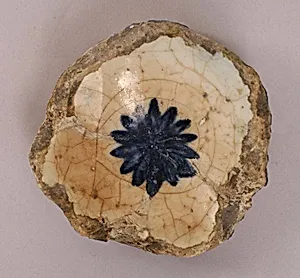
Fragment of a Bowl or Cup
Unknown Artist
13th–16th century
Medium
Stonepaste; painted under transparent glaze
Dimensions
H. 1 1/16 in. (2.7 cm) W. 2 15/16 in. (7.5 cm) D. 2 7/8 in. (7.3 cm) Wt. 2.2 oz. (62.376 g)
Classification
Ceramics
Department
Islamic Art
Museum
Metropolitan Museum of Art, New York, NY
Credit
Gift of Jack A. Josephson, 1973
Accession Number
1973.79.2
Rights
Public Domain
Tags
Art Historical Context
This delicate fragment from a bowl or cup, dating to the 13th–16th century, offers a glimpse into the refined world of Islamic ceramics. Crafted in stonepaste composite material of quartz, clay, and frit developed by artisans in the Islamic world—this small piece (just over 1 inch high) exemplifies the ingenuity of medieval potters. Stonepaste allowed for thin, translucent bodies that mimicked prized Chinese porcelain, making elegant tableware accessible beyond elite circles. Adorned with painted floral motifs under a transparent glaze, the fragment highlights a hallmark technique of the era. Flowers, a recurring theme in Islamic art, evoked paradisiacal gardens from poetry and scripture, symbolizing beauty, renewal, and divine abundance. The underglaze painting, fired to fuse colors permanently with the glassy surface, ensured vibrant durability for daily use in households across regions like Persia, Syria, or Egypt. Now in the Metropolitan Museum of Art's Islamic Art department, thanks to a 1973 gift from Jack A. Josephson, this modest shard whispers of bustling workshops and cultural exchange along ancient trade routes. Though incomplete, it captures the artistic excellence that made Islamic ceramics a global treasure.