
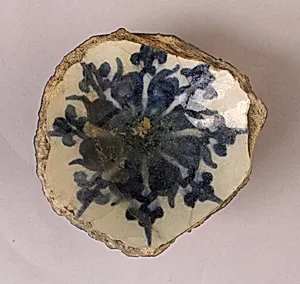
Fragment of a Bowl or Cup
Unknown Artist
13th–16th century
Medium
Stonepaste; painted under transparent glaze
Dimensions
H. 1 1/4 in. (3.2 cm) W. 2 5/8 in. (6.7 cm) D. 2 1/2 in. (6.4 cm) Wt. 2.4 oz. (68.046 g)
Classification
Ceramics
Department
Islamic Art
Museum
Metropolitan Museum of Art, New York, NY
Credit
Gift of Jack A. Josephson, 1973
Accession Number
1973.79.15
Rights
Public Domain
Art Historical Context
This delicate fragment from a bowl or cup, dating to the 13th–16th century, offers a glimpse into the refined world of Islamic ceramics. Crafted in the Islamic Art tradition, it hails from a period when artisans across the Middle East—likely in regions like Syria or Iran—perfected stonepaste, a composite body of quartz, glass frit, and clay. This innovative material mimicked the translucency of coveted Chinese porcelain, which was unavailable outside East Asia, allowing local potters to create durable, elegant vessels for daily use or elite dining. The piece's medium—stonepaste painted under a transparent glaze—highlights a sophisticated technique that emerged in the medieval Islamic world. Pigments fired beneath the glaze ensured vibrant, long-lasting colors protected by a shiny, glassy surface, often featuring intricate geometric or floral motifs (though faded here). At just 1¼ inches high and weighing a mere 2.4 ounces, this shard evokes the fragility and beauty of everyday luxury objects, underscoring the era's technical prowess and cultural emphasis on artistry in functional wares. Now part of the Metropolitan Museum of Art's collection through the generous gift of Jack A. Josephson in 1973, it reminds us how even small survivals illuminate a vibrant chapter of global ceramic history.