
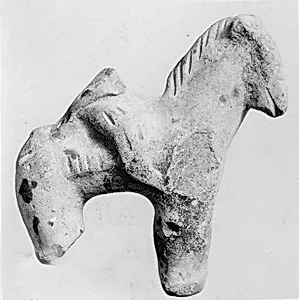
Fragment of a Horse
Unknown Artist
early 12th century
Medium
Earthenware
Dimensions
2 3/4 x 2 1/4 in. (7 x 5.7 cm)
Classification
Sculpture
Culture
Central Asia
Department
Asian Art
Museum
Metropolitan Museum of Art, New York, NY
Credit
Rogers Fund, 1930
Accession Number
30.32.58
Rights
Public Domain
Tags
Art Historical Context
This delicate earthenware fragment, depicting part of a horse, hails from Central Asia in the early 12th century—a time when nomadic and Islamic cultures flourished along the Silk Road. Horses held immense cultural significance in the region, symbolizing speed, power, and status among warriors, traders, and steppe peoples. Likely part of a larger figurine or decorative object, this small sculpture (just 2¾ x 2¼ inches) captures the animal's graceful form with simple, expressive modeling, evoking the vital role of equine companions in daily life and mythology. Crafted from earthenware—a fired clay medium prized for its accessibility and durability—this piece reflects artisanal techniques common in Central Asian workshops. Artisans hand-formed the clay, perhaps pressing it into molds before low-temperature firing, resulting in a lightweight, earthy-toned surface suited to portable votive offerings or household adornments. Though incomplete, the fragment's stylized anatomy hints at a lively, dynamic pose, showcasing the anonymous sculptor's skill in conveying motion with minimal detail. Acquired through the Rogers Fund in 1930 and now in the Metropolitan Museum of Art's Asian Art collection, this artifact offers a tangible glimpse into medieval Central Asia's vibrant material world, reminding us how everyday objects like this preserved cultural stories across centuries.