
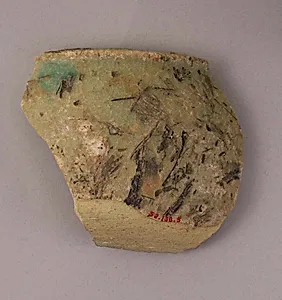
Fragment of a Jar
Unknown Artist
9th century
Medium
Earthenware; glazed
Dimensions
H. 2 5/8 in. (6.6 cm) W. 2 11/16 in. (69 cm) D. 3/8 in. (0.9 cm)
Classification
Ceramics
Department
Islamic Art
Museum
Metropolitan Museum of Art, New York, NY
Credit
Gift of Noel E. Baker, 1952
Accession Number
52.130.5
Rights
Public Domain
Tags
Art Historical Context
This delicate fragment of a glazed earthenware jar, dating to the 9th century, offers a glimpse into the vibrant of early Islamic ceramics from the Abbasid era. Produced during a golden age of artistic innovation in the Islamic world—spanning regions like Iraq, Iran, and Syria—this shard likely belonged to a larger vessel used for storing oils, spices, or water in daily life. Its modest dimensions (just over 2.5 inches high and wide) highlight the fragility of such artifacts, preserved as a testament to everyday artistry amid grand caliphal courts. The use of earthenware with a glossy glaze was revolutionary in the 9th century, marking a shift from unglazed pottery to more durable, visually appealing wares. Islamic potters mastered tin-opacified glazes, creating a smooth, reflective surface that protected the clay and enhanced its aesthetic appeal—often in shades of turquoise or green, though specifics here are lost to time. This technique influenced global ceramics, bridging utilitarian function with decorative elegance. Now housed in the Metropolitan Museum of Art's Department of Islamic Art, thanks to a 1952 gift from Noel E. Baker, this fragment invites us to ponder the anonymous hands that shaped it, embodying the ingenuity of a culture where beauty infused the ordinary.