
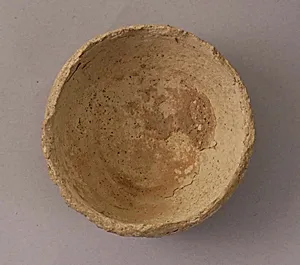
Fragment of a Jar
Unknown Artist
9th century
Medium
Earthenware; unglazed
Dimensions
H. 1 3/8 in. (3.5 cm) Diam. 2 1/8 in. (5.4 cm)
Classification
Ceramics
Department
Islamic Art
Museum
Metropolitan Museum of Art, New York, NY
Credit
Gift of Noel E. Baker, 1952
Accession Number
52.130.11
Rights
Public Domain
Tags
Art Historical Context
This delicate fragment of a jar, dating to the 9th century, offers a glimpse into the everyday world of Islamic artisans during the Abbasid era. Crafted in the Islamic world—likely regions like Iraq, Syria, or Persia—it represents the humble yet essential ceramics produced for household use, such as storing spices, oils, or water. Though only a small portion survives (measuring just 1 3/8 inches high and 2 1/8 inches in diameter), evokes the bustling pottery workshops that supplied caliphal courts and common markets alike. Made of unglazed earthenware, the fragment highlights a practical ancient technique: hand- or wheel-thrown clay fired at low temperatures to create sturdy, porous vessels. The unglazed surface allowed for natural evaporative cooling when used for liquids, a clever adaptation in hot climates. In Islamic art, such ceramics underscore the era's blend of utility and subtle artistry, bridging functional objects with the broader ceramic traditions that later inspired lustrous glazes and intricate designs. Today, this piece resides in the Metropolitan Museum of Art's Department of Islamic Art, a gift from Noel E. Baker in 1952. It reminds us that even fragments preserve cultural stories, revealing the ingenuity of anonymous makers whose work formed the backbone of medieval Islamic life.