
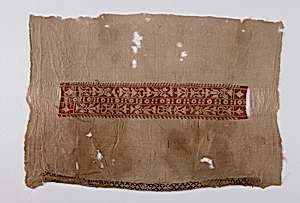
Fragment of a Sleeve
Unknown Artist
4th century
Medium
Wool, linen; plain weave, tapestry weave
Dimensions
Max. H. 11 5/8 in. (29.5 cm) Max. W. 8 1/16 in. (20.5 cm)
Classification
Textiles
Department
Islamic Art
Museum
Metropolitan Museum of Art, New York, NY
Credit
Gift of George F. Baker, 1890
Accession Number
90.5.523
Rights
Public Domain
Art Historical Context
This delicate *Fragment of a Sleeve* the 4th century us into the everyday artistry of ancient textile makers. Fashioned from wool and linen, it measures just 11⅝ by 8¹⁄₁₆ inches, preserving a portion of what was once a functional garment sleeve. Housed in the Metropolitan Museum Art's Department of Islamic Art, it entered the collection as a gift George F. Baker in1890—a rare survivor that speaks to the fragility and value of ancient fabrics. The piece showcases two key weaving techniques: plain weave, a simple over-under interlacing for durable cloth ideal for clothing, and tapestry weave, where colored wefts create discontinuous patterns directly in the fabric. These methods highlight the sophistication of 4th-century craftspeople, likely from the Near East or Egypt, where such textiles clothed people across social strata. Though the artist remains unknown, this fragment's cultural significance lies in its window to pre-Islamic life, blending utility with skilled labor. In a museum setting, it reminds us how textiles, often overlooked, wove the fabric of history—literally connecting us to hands that worked over 1,600 years ago.