
Fragment of a Tunic
Unknown Artist
4th century
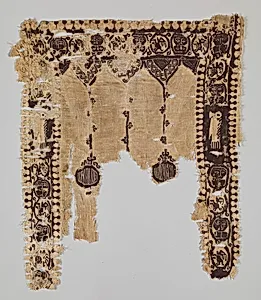
Medium
Wool, linen; plain weave, tapestry weave
Dimensions
Max. H. 16 1/2 in. (41.9 cm) Max. W. 13 1/2 in. (34.3 cm)
Classification
Textiles
Department
Islamic Art
Museum
Metropolitan Museum of Art, New York, NY
Credit
Purchase by subscription, 1889
Accession Number
89.18.217a, b
Rights
Public Domain
Art Historical Context
This delicate *Fragment of a Tunic from the 4th offers a glimpse into the everyday artistry of ancient textile makers. Crafted from wool and linen using plain weave for the sturdy ground fabric and tapestry weave for decorative elements, the piece measures about 16½ by 13½ inches. Acquired by subscription in 1889, it now resides in the Metropolitan Museum of Art's Islamic Art department highlighting the enduring legacy of woven garments in the region. Tapestry weave, a labor-intensive technique where colored weft threads are woven pictorially into the warp, allowed for vibrant, durable patterns without relying on dyes that might bleed. This method was prized for creating intricate motifs on clothing like tunics, which were essential daily wear across diverse cultures. The fragment's survival speaks to the sophistication of early weaving traditions, bridging Late Antique practices with later Islamic textile innovations. As a rare survivor from over 1,600 years ago, this tunic fragment reveals how textiles served as both functional attire and canvases for cultural expression, reflecting trade networks and skilled craftsmanship in wool and linen production. A testament to human ingenuity, it invites us to imagine the lives of those who wore it.