
Fragment
Roman period (30 BCE–641 CE), 4th/5th century
Medium
Linen and wool, slit and dovetailed tapestry weave with eccentric wefts and supplementary wrapping weft details; edged by plain weave with supplementary wrapping wefts forming uncut loop pile
Dimensions
59.2 × 51 cm (23 1/4 × 20 1/8 in.)
Classification
textile
Department
Textiles
Museum
Art Institute of Chicago
Accession Number
80385
Rights
Public Domain
About this artwork
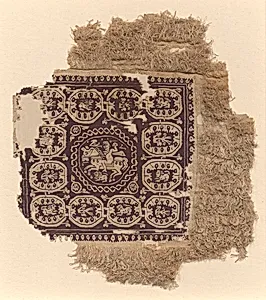
This fragment of a larger furnishing textile may have covered a bed or a sofa. The purple square, carefully woven with a tapestry technique, features contemporary imagery related to hunting, with a central rider on horseback encircled by medallions of vegetation and animals. The complete piece, comprised largely of loop pile weave, would have functioned as padding to create a soft surface. The inclusion of such a detailed tapestry design demonstrates that even an object made for comfort could al...
About the Artist
Ancient Egyptian
Ancient Egyptian artists, a collective of highly skilled artisans spanning over three millennia from the Predynastic period (c. 6000–3150 BC) to the Roman era (30 BC–4th century AD), produced some of humanity's most enduring masterpieces. These anonymous craftsmen, often organized in state-sponsored workshops, lived in dedicated communities like Deir el-Medina near Luxor during the New Kingdom (c....