
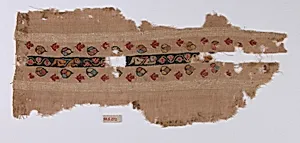
Fragment of a Tunic
Unknown Artist
5th century
Medium
Wool, linen; plain weave, tapestry weave
Dimensions
Max. H. 12 in. (30.1 cm) Max. W. 4 3/4 in. (12.1 cm)
Classification
Textiles
Department
Islamic Art
Museum
Metropolitan Museum of Art, New York, NY
Credit
Gift of George F. Baker, 1890
Accession Number
90.5.272
Rights
Public Domain
Art Historical Context
This delicate fragment of a tunic, to the 5th century, offers a rare glimpse into the everyday textiles of the ancient world. Crafted from wool and linen, it just 12 inches high and 4¾ inches wide, likely part of a larger garment worn in the Near East or Egypt during a time of cultural exchange between Byzantine, Sasanian, and early pre-Islamic societies. Housed in the Metropolitan Museum of Art's Islamic department as a gift from George F. Baker in 1890, it exemplifies the fragility and preciousness of surviving ancient fabrics. The artwork showcases sophisticated weaving techniques: a plain weave for the sturdy ground fabric, combined with tapestry weave for decorative elements. Tapestry weave, where colored weft threads are woven to create patterns without floats, allowed artisans to produce vibrant motifs efficiently, often depicting geometric or floral designs symbolic of the region's burgeoning artistic traditions. As a textile fragment, it highlights the cultural importance of clothing in early societies, where garments conveyed status and artistry. Such pieces are invaluable for understanding pre-Islamic weaving prowess, which influenced later Islamic textile traditions, bridging ancient craftsmanship with enduring legacies.