
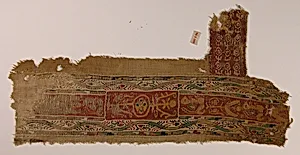
Fragment of a Tunic
Unknown Artist
6th century
Medium
Wool, linen; plain weave, tapestry weave
Dimensions
Max. H.15 3/8 in. (39 cm) Max. W. 7 5/16 in.(18.5 cm)
Classification
Textiles
Department
Islamic Art
Museum
Metropolitan Museum of Art, New York, NY
Credit
Gift of George F. Baker, 1890
Accession Number
90.5.290
Rights
Public Domain
Art Historical Context
This delicate fragment of a tunic, dating to the 6th century, offers a rare glimpse into everyday life in the ancient Near East or Egypt during the late antique period. Crafted from wool and linen using weave for the sturdy ground fabric and tapestry weave for decorative bands, it exemplifies the sophisticated textile traditions of the era. At just 15⅜ inches high and 7¼ inches wide, this surviving piece—likely from a garment worn by ordinary people—highlights the perishability of ancient clothing and the skill of anonymous weavers. Tapestry weave, where colored wefts create vivid motifs without underlying warps visible, allowed for intricate patterns in a portable medium. Such techniques were widespread in regions bridging the Byzantine and early Islamic worlds, producing tunics adorned with geometric, floral, or figural designs that reflected cultural exchanges along trade routes. Housed in the Metropolitan Museum of Art's Islamic Art department as a gift from George F. Baker in 1890, this textile underscores the continuity of craft traditions into the Islamic era. For museum visitors, it evokes the vibrancy of long-lost wardrobes, reminding us how fragments preserve stories of artistry and daily existence from over 1,500 years ago.