
Fragment of a Tunic
Unknown Artist
4th–5th century
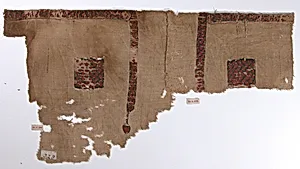
Medium
Wool, linen; plain weave, tapestry weave
Dimensions
Max. H. 10 5/8 in. (27 cm) Max. W. 9 5/16 in. (23.7 cm)
Classification
Textiles
Department
Islamic Art
Museum
Metropolitan Museum of Art, New York, NY
Credit
Gift of George F. Baker, 1890
Accession Number
90.5.296
Rights
Public Domain
Art Historical Context
This exquisite *Fragment of a Tunic from the 4th–5th century invites us into the world of Late Antique daily life, where clothing blended functionality with artistry. Woven from wool and linen, the piece employs a plain weave for its sturdy base—ideal for everyday wear—and tapestry weave to create colorful, pictorial patterns directly in the fabric. Measuring just 10⅝ by 9⅜ inches, this surviving remnant hints at a once-vibrant garment, likely part of a tunic worn across diverse communities in the ancient Near East or eastern Mediterranean. Tapestry weave, a sophisticated technique, allowed weavers to interlace dyed threads without supplementary sewing, producing durable motifs that withstood wear. Such textiles showcase the era's mastery of natural fibers and dyes, reflecting cultural exchanges along trade routes. Classified in the Metropolitan Museum of Art's Department of Islamic Art and gifted by George F. Baker in 1890, it bridges pre-Islamic craftsmanship with later traditions, underscoring textiles' role in preserving history through fragile threads. Though small, this fragment reveals how ordinary objects carried profound artistic value, offering museum visitors a tangible link to lives lived over 1,500 years ago.