
Textile Fragment
Unknown Artist
3rd–4th century
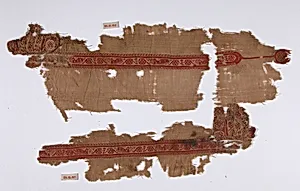
Medium
Wool, linen; plain weave, tapestry weave
Dimensions
Max. H. 15 11/16 in. (39.8 cm) Max. W. 13/16 in. (2.1 cm)
Classification
Textiles
Department
Islamic Art
Museum
Metropolitan Museum of Art, New York, NY
Credit
Purchase by subscription, 1889
Accession Number
89.18.199
Rights
Public Domain
Art Historical Context
This delicate textile fragment, dating to the 3rd–4th century, offers a glimpse into the sophisticated weaving traditions of the late antique world. Crafted from wool and linen plain weave for the foundation and tapestry weave for decorative elements, it measures a slender 15 11/16 inches high by just 13/16 inches wide. Acquired by the Metropolitan Museum of Art in 9 through a subscriber purchase, it resides in the museum's Islamic Art department, textiles from regions that would later flourish under Islamic influence. The combination of plain and tapestry weaves reflects advanced technical skill: plain weave provided a sturdy ground cloth, while tapestry weave allowed to create intricate patterns by interweaving colored weft threads, a labor-intensive method ideal for small-scale motifs on garments, furnishings, or ritual objects. Such fragments often survived in arid environments like Egypt, preserving vibrant dyes and designs from everyday life. Though the artist remains unknown, this piece underscores the cultural importance of textiles in pre-Islamic societies of the Near East and North Africa. As a survivor from over 1,700 years ago, it connects us to ancient makers whose handiwork adorned bodies and homes, bridging late antiquity to the Islamic era celebrated in the Met's collection.