
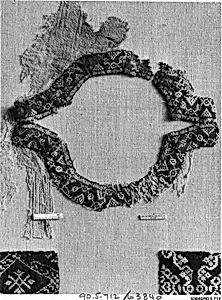
Fragment of a Tunic
Unknown Artist
5th–6th century
Medium
Wool, linen; plain weave, tapestry weave
Dimensions
Max. H. 7 7/8 in. (20 cm) Max. W. Max. Band W. 1 3/16 in. (3 cm)
Classification
Textiles
Department
Islamic Art
Museum
Metropolitan Museum of Art, New York, NY
Credit
Gift of George F. Baker, 1890
Accession Number
90.5.712
Rights
Public Domain
Art Historical Context
This delicate *Fragment of a Tunic* from the 5th–6th century offers a glimpse into the daily lives of people in the late ancient world, likely from regions under early Islamic cultural influence. Crafted from wool and linen using plain weave for the base fabric and tapestry weave for decorative bands, it measures just 7 7/8 inches high and 1 3/16 inches at its banded edges. Such fragments, preserved through arid burial conditions, are rare survivors of everyday garments worn by common folk. The dual weaving techniques highlight skilled craftsmanship: plain weave provided sturdy, breathable cloth ideal for tunics, while tapestry weave allowed for vibrant, pictorial motifs in the narrow bands—often featuring geometric patterns, animals, or figures that conveyed status or protection. These methods reflect advanced textile production hubs, possibly in Egypt, where wool from local sheep and imported linen intertwined in workshops. Housed in the Metropolitan Museum of Art's Islamic Art Department as a gift from George F. Baker in 1890, this piece underscores the cultural continuity of textile arts across empires. It invites us to imagine the wearer navigating bustling markets or desert travels, reminding visitors of how fragile fabrics bridge us to ancient stories of labor, trade, and identity.