
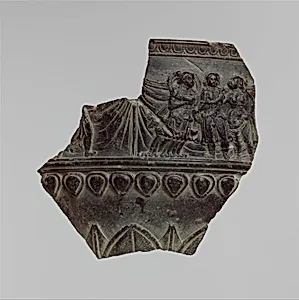
Fragment of a Vessel with a Dionysian Scene
Unknown Artist
1st century
Medium
Schist
Dimensions
H. 5 in. (12.7 cm)
Classification
Sculpture
Culture
Pakistan (ancient region of Gandhara)
Department
Asian Art
Museum
Metropolitan Museum of Art, New York, NY
Credit
Samuel Eilenberg Collection, Bequest of Samuel Eilenberg, 1998
Accession Number
2000.284.15
Rights
Public Domain
Tags
Art Historical Context
This exquisite fragment of a schist vessel, hailing from the ancient Gandhara region of modern-day Pakistan, dates to the 1st century CE. Carved in low relief, it captures a lively Dionysian scene—evoking the Greek god of wine, revel, and ecstasy—amidst human figures in dynamic poses. Standing just 5 inches tall, this small sculpture exemplifies Gandhara's masterful stonework, where schist, a durable metamorphic rock, was prized for its fine grain and ability to hold intricate details. Gandhara art, flourishing under Kushan rule, brilliantly fused Greco-Roman influences from Alexander the Great's legacy with local Indian traditions, often blending pagan mythology with emerging Buddhist themes. The presence of Dionysus here highlights cultural exchange along the Silk Road, where Hellenistic motifs like bacchanalian feasts adorned vessels for rituals or daily use. Though only a fragment survives, it offers a window into the cosmopolitan world of ancient Pakistan. Housed in the Metropolitan Museum of Art's Asian Art Department as part of the Samuel Eilenberg Collection (1998 bequest), this piece invites visitors to ponder how distant gods traveled and transformed in far-flung lands.