
Fragment of a Waster
Unknown Artist
11th–12th century
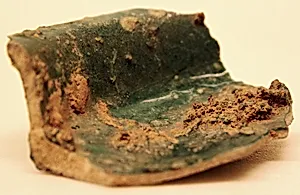
Medium
Stonepaste; buff body under transparent alkaline glaze
Dimensions
H. 1 1/4 in. (3.2 cm) W. 2 5/8 in. (6.7 cm) D. 2 3/8 in. (6 cm) Wt. 1.1 oz. (31.2 g)
Classification
Ceramics
Department
Islamic Art
Museum
Metropolitan Museum of Art, New York, NY
Credit
Rogers Fund, 1948
Accession Number
48.101.49
Rights
Public Domain
Art Historical Context
This delicate fragment, known as a *Waster*, hails from the Islamic world of the 11th–12th century and offers a glimpse into the artistry of medieval ceramic workshops. Measuring just over an inch high, it is a small shard of stonepaste—a composite material made from quartz, clay, and frit (ground glass)—with a buff-colored body coated in a transparent alkaline glaze. Produced in the Department of Islamic Art at The Metropolitan Museum of Art (quired via the Rogers Fund in 1948), it exemplifies the ingenuity of artisans in regions like Iran or Syria during the Seljuk era. A "waster" refers to a flawed piece discarded during production, often due to cracks or warping in the kiln. These rejects, though imperfect, are invaluable to historians, revealing the trial-and-error of crafting high-fired ceramics. Stonepaste was a revolutionary technique in Islamic pottery, mimicking the translucency of coveted Chinese porcelain long before it reached the West. The alkaline glaze, made from plant ash rather than lead, created a brilliant sheen and protected the friable body, enabling intricate designs on vessels, tiles, and lusterware. Though incomplete, this fragment underscores the cultural flourishing of Islamic ceramics, where potters pushed technical boundaries to produce objects of beauty and utility for courts and mosques. It invites us to appreciate the unseen labor behind enduring masterpieces.