
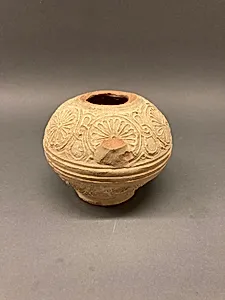
Fragment of an Ewer
Unknown Artist
9th–11th century
Medium
Earthenware; molded decoration and unglazed
Dimensions
Ht. 4 3/4 in. (12 cm) Diam. 5 3/4 in. (14.6 cm)
Classification
Ceramics
Department
Islamic Art
Museum
Metropolitan Museum of Art, New York, NY
Credit
Rogers Fund, 1940
Accession Number
40.170.186
Rights
Public Domain
Art Historical Context
This delicate fragment from an ewer, dating to the 9th–11th, offers a glimpse into the refined ceramic traditions of the early Islamic world. Ewers like this were practical vessels, likely used for pouring water during ablutions or daily rituals, embodying the blend of utility and artistry in Abbasid-era households. Though only a portion survives—measuring 4 3/4 inches high and 5 3/4 inches in diameter hints at the original object's graceful form, now housed in the Metropolitan Museum of Art Islamic Art Department, acquired through the Rogers Fund in 1940. Crafted from unglazed earthenware with molded decoration, the piece showcases a sophisticated technique where clay was pressed into intricately carved molds to create raised patterns. This method, prevalent in regions like Iraq and Iran, allowed artisans to produce repeatable, textured designs without glazing, highlighting the tactile beauty of the buff-colored clay. Unglazed ceramics were prized for their earthy authenticity, contrasting with later glazed wares, and reflect early Islamic potters' mastery in mimicking more precious materials like metal or stone. As a testament to anonymous craftsmanship, this fragment underscores the cultural flourishing of Islamic ceramics during a golden age of innovation, where everyday objects became canvases for subtle elegance. Visitors can appreciate how such pieces bridged art and life in medieval Islamic society.