
Textile Fragment
Unknown Artist
7th–8th century
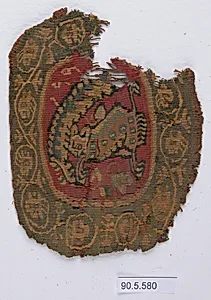
Medium
Wool, linen; plain weave, tapestry weave
Dimensions
Max. H. 4 1/2 in. (11.5 cm) Max. W. 3 5/8 in. (9.2 cm)
Classification
Textiles
Department
Islamic Art
Museum
Metropolitan Museum of Art, New York, NY
Credit
Gift of George F. Baker, 1890
Accession Number
90.5.580
Rights
Public Domain
Art Historical Context
This exquisite *Textile Fragment* from the 7th–8th century offers a glimpse into the vibrant of early Islamic artistry. Housed in the Metropolitan Museum of Art's Islamic Department, this small piece—measuring just 4½ by 3⅝ inches—was crafted from wool and linen using plain weave for the foundation and tapestry weave decorative elements. Donated in 1890 by George. Baker, it survives as a precious remnant of a larger textile, likely used for clothing, furnishings, or ceremonial purposes during the formative centuries of Islamic culture under the Umayyad and early Abbasid caliphates. The interplay of plain and tapestry weaves highlights sophisticated textile techniques prevalent in the Islamic world. Plain weave provided a sturdy base, while tapestry weave allowed artisans to create intricate patterns with discontinuous colored wefts, a method borrowed and refined from pre-Islamic traditions like those of the Sasanians and Byzantines. These fragments are rare survivors, as organic materials rarely endure; this one showcases the high level of craftsmanship in regions from Egypt to Central Asia, where textiles were prized for trade, status, and daily life. Today, such artifacts illuminate the cultural crossroads of the early Islamic era, blending utility with artistry. Though its full design is lost, the fragment whispers of opulent patterns—geometric motifs or floral motifs—that defined Islamic aesthetic innovation.