
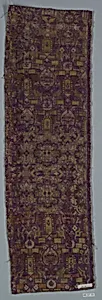
Fragment of Sash
Unknown Artist
18th century
Medium
Silk; woven
Dimensions
H. 21 1/8 in. (53.7 cm) W. 6 1/4 in. (15.9 cm)
Classification
Textiles-Woven
Department
Islamic Art
Museum
Metropolitan Museum of Art, New York, NY
Credit
Gift of the Museum of the Cranbrook Academy of Art, 1946
Accession Number
46.37.13
Rights
Public Domain
Art Historical Context
This exquisite *Fragment of Sash*, in the 18th century from finely woven silk, offers a glimpse into the opulent textile traditions of the Islamic world. Measuring 21 1/8 inches high and 6 1/4 inches wide, narrow strip likely once adorned a garment as a decorative sash, accentuating the waist or securing robes in elite wardrobes. Housed in the Metropolitan Museum of Art's Islamic Department, it entered the collection in 1946 as a gift from the Museum of thebrook Academy of Art, preserving a delicate piece of history. Woven silk was a pinnacle of Islamic craftsmanship during this era, prized for its luxurious sheen and durability. Artisans employed complex loom techniques to create intricate patterns—though faded here, they would have featured motifs like florals, geometrics, or arabesques symbolic of paradise gardens or eternal patterns in Islamic design. Such textiles, often produced in centers like Istanbul, Cairo, or Isfahan, showcased technical mastery and served as status symbols in courts and among the wealthy. As a surviving fragment, this sash fragment highlights the fragility of textiles and their cultural role in daily splendor. It invites us to imagine vibrant ceremonies or intimate moments where silk whispered luxury, bridging art and life in the 18th-century Islamic realms.