
Fragment
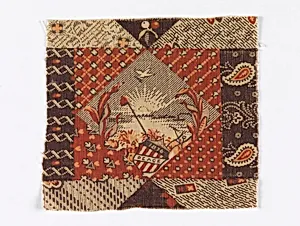
Classification
printed, dyed & painted textiles
Department
Smithsonian Collection
Museum
Smithsonian American Art Museum
Credit
Gift of Lillian Smith Albert
Accession Number
1959-10-2
Rights
Public Domain
About this artwork
Research in Progress
Art Historical Context
This delicate *Fragment* from Cocheco Print Works in, New Hampshire, dates to 1876, a snapshot of America's booming textile industry during the Gilded Age. Produced by one of New England's leading mills, renowned for its innovative roller-printing techniques, this piece exemplifies the mass production of colorful, patterned fabrics that adorned homes and clothing across the nation. As a printed, dyed, and painted textile, it likely features intricate floral or geometric motifs typical of Victorian-era designs, blending artistry with industrial efficiency. Cocheco Print Works thrived in the post-Civil War era, when textile manufacturing fueled economic growth in mill towns like Dover. Techniques such as woodblock or cylinder printing allowed for vibrant, repeatable patterns on cotton or wool, making decorative textiles accessible to middle-class families. Though the exact medium remains under study—part of ongoing research at the Smithsonian American Art Museum—this fragment preserves the craftsmanship of an industry that symbolized American ingenuity and cultural refinement. Today, housed in the Smithsonian Collection as a gift from Lillian Smith Albert, it offers a tangible link to 19th-century daily life, highlighting how everyday objects carried artistic value. Visitors can appreciate its role in the evolution of American design, bridging handcraft traditions with mechanized production.