
Fragment veelkleurig, complex zijdeweefsel
1700 - 1725
Medium
brocaded
Dimensions
26; 44; 0.5
Rights
Public Domain
About this artwork
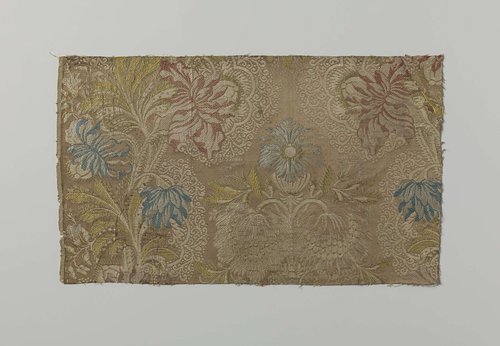
Een fragment van licht bruin zijdeweefsel met een palmet omgeven door bloemen en kantmotief.
Art Historical Context
This exquisite fragment, titled *Fragment veelkleurig, complex zijdeweefsel*, is a rare survivor from the early 18th century (1700–1725), showcasing the artistry of anonymous silk weavers. Measuring just 26 cm high by 44 cm wide, it features a light brown silk ground adorned with a central palmette—a stylized palm leaf motif—encircled by blooming flowers and delicate lace-like patterns. The multicolored, complex weave highlights the opulence of Baroque-era textiles, likely intended for luxurious garments, furnishings, or ecclesiastical vestments. The brocading technique elevates this piece: extra weft threads are woven in to create raised, shimmering motifs against the base fabric, demanding immense skill and specialized looms. Such silks were produced in weaving hubs like Lyon or Italy, symbols of wealth and status amid Europe's flourishing trade in exotic dyes and materials. The palmette, with roots in ancient classical and Islamic designs, blended Eastern influences with Western floral exuberance, reflecting the era's global exchange. Today, this fragment captivates as a testament to forgotten craftsmanship, preserving the tactile splendor of a bygone luxury trade and inviting us to imagine the hands that wove its intricate beauty.
About the Artist
anonymous
In the vast tapestry of art history, "Anonymous" stands not as a singular individual but as a collective designation for countless unidentified creators whose works have endured across millennia. These artists, spanning prehistoric cave painters to medieval illuminators and folk craftsmen, produced the foundational layers of human visual culture. Prior to the Renaissance, when individual fame emer...