
Fragment with Scattered Pattern
Unknown Artist
6th–8th century
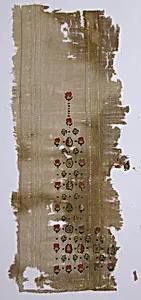
Medium
Wool, linen; plain weave, tapestry weave
Dimensions
Max. H. 18 7/8 in. (48 cm) Max. W. 8 1/16 in. (20.5 cm)
Classification
Textiles
Department
Islamic Art
Museum
Metropolitan Museum of Art, New York, NY
Credit
Gift of George F. Baker, 1890
Accession Number
90.5.483
Rights
Public Domain
Art Historical Context
This delicate textile fragment, titled *Fragment with Scattered Pattern hails from the 6th–8th and offers a glimpse into the vibrant world of early Islamic art. Likely originating from regions under Islamic influence, such as Egypt or the Near East, it exemplifies the period's transition from late antiquity to the formative years of Islam, when intricate patterns symbolized prosperity, protection, and aesthetic harmony. The "scattered" motifs—abstract motifs dispersed across the surface—reflect a budding Islamic decorative tradition that avoided figurative imagery, favoring geometric and floral elements that would evolve into hallmarks of later Islamic design. Crafted from wool and linen using a combination of plain weave for the foundation and tapestry weave for the colorful patterns, this piece showcases sophisticated textile techniques. Tapestry weave, with its discontinuous wefts, allowed artisans to interlace dyed yarns efficiently, creating bold, multi-hued designs without wasting material—a practical innovation for both everyday garments and luxurious hangings. At just 18⅞ by 8⅛ inches, the fragment survives as a testament to the fragility of ancient fabrics, preserved through arid climates and now housed in the Metropolitan Museum of Art's Islamic Art Department, thanks to a 1890 gift from George F. Baker. For visitors, this unassuming remnant whispers of bustling workshops and far-flung trade routes, inviting us to ponder the skilled hands that wove beauty into the fabric of daily life.