
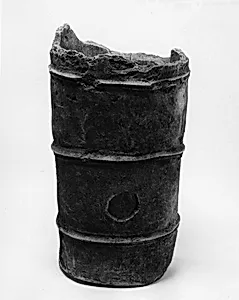
Fragmentary haniwa cylinder
Unknown Artist
5th–6th century
Medium
Clay
Dimensions
H. 16 1/2 in. (41.9 cm); Diam. 8 1/2 in. (21.6 cm)
Classification
Sculpture
Culture & Period
Japan · Kofun period (ca. 300–710)
Department
Asian Art
Museum
Metropolitan Museum of Art, New York, NY
Credit
Gift of Asia Society, 1981
Accession Number
1981.244.2
Rights
Public Domain
Art Historical Context
This fragmentary haniwa cylinder, crafted from clay during Japan's Kofun period (ca. 300–710 CE), offers a glimpse into one of the earliest forms of sculptural art in East Asia. Dating to the 5th–6th century it stands about 16½ inches tall and 8½ inches in diameter, its simple cylindrical shape typical of haniwa—unglazed earthenware objects placed around massive keyhole-shaped burial mounds known as kofun. These mounds, built for elite warriors and chieftains, symbolized power and marked the transition from Yayoi to an emerging Yamato state, foreshadowing imperial Japan. Haniwa like this one served vital funerary roles, likely acting as spirit guardians or substitutes for human sacrifices, warding off evil and honoring the deceased in animistic beliefs. Though fragmentary, it exemplifies low-fired clay techniques: hand-coiled or molded, with a textured surface that evokes the period's rustic yet monumental aesthetic. Unlike later refined Japanese ceramics, haniwa prioritized quantity and symbolism over finesse, with thousands once encircling tombs. Today, housed in the Metropolitan Museum of Art's Asian Art Department as a gift from the Asia Society in 1981, this piece highlights Kofun innovation in three-dimensional form, bridging archaeology and art to reveal ancient Japan's ritual world. Visitors can imagine it amid a sea of similar cylinders, rising solemnly from misty hillsides.