
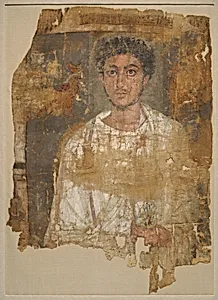
Fragmentary Shroud with a Bearded Young Man
Unknown Artist
A.D. 120–150
Medium
Linen, tempera paint
Dimensions
100.6 × 69 cm (39 5/8 × 27 3/16 in.); Frame: 109.2 × 81.3 × 3.2 cm (43 × 32 × 1 1/4 in.)
Classification
Shroud fragment, bearded man; 138-VGM
Period
Roman Period
Department
Egyptian Art
Museum
Metropolitan Museum of Art, New York, NY
Credit
Rogers Fund, 1908
Accession Number
08.202.8a
Rights
Public Domain
Tags
About this artwork
This fragmentary painted shroud depicts a bearded young man with wide eyes and an incipient mustache, standing against a dark gray background with a lighter gray area surrounding his head like a halo. Created in tempera on linen between A.D. 120 and 150, the portrait shows the deceased holding a bundle of foliage, possibly myrtle, in his hand. The painting measures approximately forty by twenty-seven inches and exemplifies the distinctive funerary portrait tradition that flourished in Roman Egyp...
Art Historical Context
This fragmentary shroud from Roman Egypt, created between A.D. and 150, portrays a bearded young man with wide eyes and an incipient mustache against a dark gray background. Painted in tempera on linen, the figure stands frontally while holding a bundle of foliage, possibly myrtle. Measuring roughly 100 by 69 centimeters, the work served as a funerary covering for the deceased, replacing traditional Egyptian mummy masks with a more lifelike image. The piece belongs to the Fayum portrait tradition, one of the earliest surviving examples of panel painting in the European lineage. Affluent Egyptians living under Roman rule commissioned such portraits during their lifetimes or shortly after death. Artists applied tempera to linen to capture individual features with remarkable naturalism, blending Greco-Roman artistic conventions with longstanding Egyptian burial customs. Acquired by the Metropolitan Museum in 1908, this shroud highlights a unique cultural synthesis. The direct gaze and preserved colors create an intimate connection across nearly two millennia, revealing how Roman-period Egyptians honored the dead while embracing new artistic approaches.