
Fragments
1000-1476
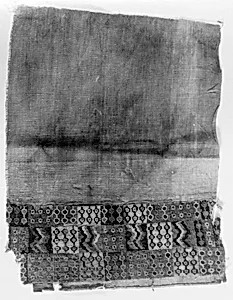
Medium
Plain cloth with interlocking tapestry
Dimensions
a: 33 × 26.7 cm (13 × 10 1/2 in.); b: 63.5 × 26.7 cm (25 × 10 1/2 in.)
Classification
textile
Department
Textiles
Museum
Art Institute of Chicago
Accession Number
85232
Rights
Public Domain
Art Historical Context
These textile fragments, created by artists of theca culture on Peru’s southern coast between 1000 and 1476, showcase the remarkable skill of Andean weavers during the Late Intermediate Period. Produced in plain cloth with interlocking tapestry, the pieces demonstrate a technique in which colored weft threads interlock at their meeting points, creating durable, seamless designs without the slits common in other tapestry methods. Such textiles were far more than utilitarian objects; in Andean societies they served as markers of identity, rank, and ritual importance, often buried with the deceased as symbols of status and continuity. Measuring roughly the size of small panels, the fragments likely once formed part of larger garments or ceremonial cloths. Their survival offers a rare window into pre-Inca artistic traditions, when coastal communities developed sophisticated weaving technologies that later influenced Inca textile arts. The interlocking method allowed for precise geometric or figural motifs while maintaining structural strength, reflecting both aesthetic refinement and practical ingenuity. Today these works reside in the Art Institute of Chicago’s textile collection, where they remind visitors of the central role cloth played in Andean life—functioning as a visual language that communicated cultural values across generations.