
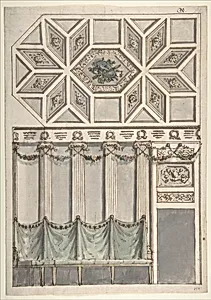
Framed Design for an Architectural Interior: Coffered Ceiling with Central Hexagonal Cartouche and Walls with Floral Ornament and Drapery.
1774–1839
Medium
Pen and brown ink, brush and brown, gray, blue, orange, green wash, over traces of graphite
Dimensions
Sheet: 16 1/2 x 11 5/8 in. (41.9 x 29.6 cm)
Classification
Drawings
Department
Drawings and Prints
Museum
Metropolitan Museum of Art, New York, NY
Credit
The Elisha Whittelsey Collection, The Elisha Whittelsey Fund, 1967
Accession Number
67.689.11
Rights
Public Domain
Tags
Art Historical Context
Behold this elegant *Framed Design for an Architectural Interior: Coffered Ceiling with Central Hexagonal Cartouche and Walls with Floral Ornament and Drapery* by Antonio Basoli (1774–1839), a master draftsman from Italy's late Enlightenment era. Created around the early 19th century, this preparatory drawing envisions a sophisticated room with a richly paneled coffered ceiling—its recessed squares adding depth and grandeur—and walls blooming with intricate floral motifs framed by luxurious drapery. The central hexagonal cartouche serves as a focal point, likely intended for a painted emblem or coat of arms, evoking the opulent interiors of palaces and villas. Executed in pen and brown ink with vibrant brush washes in brown, gray, blue, orange, and green over faint graphite underdrawing, Basoli's technique reveals the precision of architectural planning. These mixed media allowed for subtle shading and color to simulate textures, from the coffers' shadows to the fabrics' folds, bridging two-dimensional sketch to three-dimensional reality. Coffered ceilings, rooted in ancient Roman designs, symbolized wealth and acoustic refinement in neoclassical spaces. Housed in the Metropolitan Museum of Art's Drawings and Prints Department as part of The Elisha Whittelsey Collection (acquired 1967), this sheet highlights the artistry behind everyday grandeur. It invites us to appreciate how such designs shaped cultured living, blending utility with beauty in an age of revivalist elegance.