
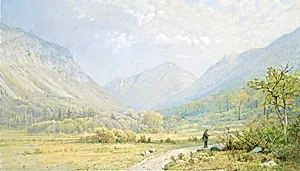
Franconia Notch, New Hampshire
Medium
Watercolor, gouache, and graphite on light tan wove paper
Dimensions
8 3/16 x 14 1/4 in. (20.8 x 36.2 cm)
Classification
Watercolor
Culture
American
Department
The American Wing
Museum
Metropolitan Museum of Art, New York, NY
Credit
Gift of The Reverend E. L. Magoon, D.D., 1880
Accession Number
80.1.5
Rights
Public Domain
Tags
Art Historical Context
William Trost Richards captures the majestic drama of Franconia Notch, New Hampshire, in this 1872 watercolor, gouache, and graphite drawing on light tan wove paper. Measuring just8 3/16 x 14 1/4 inches, the intimate work depicts towering mountains, winding roads, and distant figures of men traversing the landscape, evoking the sublime power of the American wilderness. As a prominent member of the Hudson River School, Richards was renowned for his meticulous renderings of nature, blending Romantic awe with precise observation during the post-Civil War era when Americans sought solace and national identity in their expansive landscapes. The mixed media technique showcases Richards' mastery: translucent watercolors and opaque gouache build luminous depth and texture, while graphite adds fine details to rocky crags and foliage. This approach highlights the White Mountains' popularity as a 19th-century tourist destination, immortalized by artists who hiked and sketched en plein air. Donated to the Metropolitan Museum of Art in 1880 by The Reverend E. L. Magoon, the piece reflects early philanthropy in building American art collections. Today, in The American Wing, it invites visitors to ponder how such scenes fostered a sense of exploration and preservation amid rapid industrialization, reminding us of nature's enduring allure.
About the Artist
William Trost Richards · 1833–1905
William Trost Richards (1833–1905) was a prominent American landscape and marine painter born in Philadelphia, where he attended Central High School before beginning his artistic training. Between 1850 and 1855, he studied part-time under the German-born Hudson River School artist Paul Weber while working as a designer and illustrator of ornamental metalwork. He exhibited his first works at the Pe...