
Frau D.S.
1917
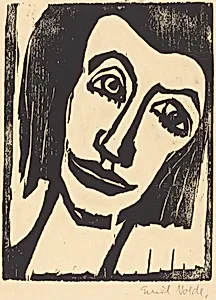
Medium
woodcut
Classification
Department
CG-W
Museum
National Gallery of Art, Washington, D.C.
Credit
Ruth and Jacob Kainen Collection
Accession Number
1977.70.4
Rights
Public Domain
Art Historical Context
**Emil Nolde's *Frau D.S.* (1917)** Step into the vibrant world of German Expressionism with Emil Nolde's striking woodcut *Frau D.S.*, created amid the turmoil of World War I. Nolde, a pioneering member of the Die Brücke group, channeled raw emotion through distorted forms and intense contrasts, rejecting academic realism for a deeply personal vision. This portrait, housed in the National Gallery of Art's Ruth and Jacob Kainen Collection (Department CG-W), captures the era's psychological intensity, reflecting the artist's fascination with human expression during a time of global upheaval. As a woodcut—a relief printing technique where the artist carves into wood blocks to create bold, textured lines—*Frau D.S.* exemplifies Nolde's mastery of the medium. Woodcuts, favored by Expressionists for their primal, direct quality, allowed affordable reproduction of radical ideas, bridging fine art and popular culture. The stark blacks and whites evoke a haunting immediacy, highlighting Nolde's innovative approach to printmaking that influenced modern graphic arts. This poignant work invites you to ponder the inner life of its enigmatic subject, Frau D.S., through Nolde's unflinching gaze. A testament to early 20th-century innovation, it remains a highlight of the print collection, celebrating the power of simplicity in conveying profound feeling.
About the Artist
Emil Nolde · 1867–1956
Emil Nolde, born Hans Emil Hansen on August 7, 1867, near the village of Nolde in what was then Prussian Schleswig (now Denmark), grew up on a farm amid devout Protestant Danish and Frisian peasant parents. The youngest of four brothers, he apprenticed as a woodcarver and illustrator in Flensburg from 1884 to 1891, working in furniture factories before studying at the School of Applied Arts in Kar...