
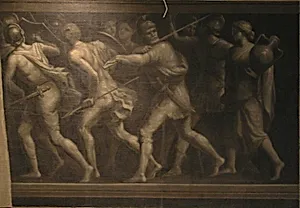
Frieze fragment
ca. 1520–35
Medium
Oil on canvas
Dimensions
Overall: 38 3/16 × 56 5/16 in. (97 × 143 cm)
Classification
Paintings-Decorative
Culture
Italian, Rome
Department
European Sculpture and Decorative Arts
Museum
Metropolitan Museum of Art, New York, NY
Credit
Gift of Gioia and Marcello Aldega, 1998
Accession Number
1998.238
Rights
Public Domain
Tags
Art Historical Context
Behold this captivating *Frieze fragment* by Polidoro da Caravaggio, a masterful Italian artist active in Rome around 1520–35. Painted in oil on canvas—a medium that allowed for rich color and portability in the Renaissance—this expansive piece (nearly 5 by 4.5 feet) evokes the grandeur of ancient Roman decorative arts. As a fragment of a larger frieze, likely adorned a facade or interior wall, blending High Renaissance elegance with emerging Mannerist flair. Polidoro, a contemporary of Raphael, specialized in illusionistic scenes mimicking classical reliefs, populating them with lively figures of men and women in dynamic poses. This work, classified as decorative painting and housed in the Metropolitan Museum of Art's European Sculpture and Decorative Arts department, captures that spirit. The inclusion of both male and female figures suggests narrative vignettes from mythology or daily life, rendered with dramatic chiaroscuro to imitate sculpted stone. Generously gifted to the Met in 1998 by Gioia and Marcello Aldega, this fragment offers a window into Rome's vibrant artistic scene during the Sack of Rome era (1527), when such bold decorations symbolized cultural resilience. A testament to Polidoro's ingenuity, it invites visitors to ponder the interplay of architecture, painting, and antiquity.
About the Artist
Polidoro da Caravaggio · 1492–present
Polidoro Caldara, known as Polidoro da Caravaggio, was born around 1499 in Caravaggio, Lombardy, and emerged as one of the most innovative painters of the early Mannerist period. Arriving in Rome circa 1515 as an untrained laborer hauling plaster for the Vatican Logge decorations, he quickly caught the eye of Raphael's key assistant, Maturino da Firenze. By 1517, Polidoro had joined Raphael's work...