
Frieze
1919-1920
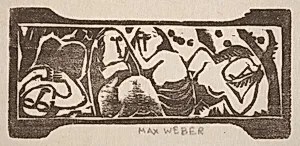
Medium
woodcut in black on laid paper
Dimensions
image (irregular): 4.75 × 10.5 cm (1 7/8 × 4 1/8 in.) sheet: 15.24 × 15.88 cm (6 × 6 1/4 in.)
Classification
Department
CG-W
Museum
National Gallery of Art, Washington, D.C.
Credit
Gift of Jack and Margrit Vanderryn
Accession Number
1997.128.3
Rights
Public Domain
Art Historical Context
Max Weber's *Frieze* (1919–1920) is a striking woodcut print in black ink on laid paper, capturing the spirit of the early 20th century. Measuring just 4 3/4 × 10 1/2 inches for its irregular image on a 6 × 6 1/4-inch sheet, this intimate work invites visitors to lean in and trace its rhythmic lines. Created shortly after World War I, reflects Weber's evolution as a Russian-born American artist who embraced Cubism, Expressionism, and Primitivism, blending European avant-garde influences with his Jewish heritage. The woodcut medium— a relief printing technique involving carving into wood blocks—lends *Frieze* its bold contrasts and tactile quality, evoking the linear procession of ancient architectural friezes while nodding to modernist abstraction. Weber, active in New York's vibrant art scene, used prints like this to experiment with form and pattern, making high art accessible through editioned works. Housed in the National Gallery of Art's print collection (Department CG-W) as a gift from Jack and Margrit Vanderryn, *Frieze* exemplifies Weber's innovative graphic style during a transformative era, bridging tradition and innovation for enduring appeal.
About the Artist
Max Weber · 1881–1961
Max Weber (1881–1961), born in Białystok in the Russian Empire (now Poland) to Orthodox Jewish parents, immigrated to Brooklyn, New York, at age ten with his family, joining his tailor father.) There, he pursued art studies at the Pratt Institute under Arthur Wesley Dow, an innovative teacher who emphasized expression and form over traditional narrative, drawing from Japanese art and Paul Gauguin....