
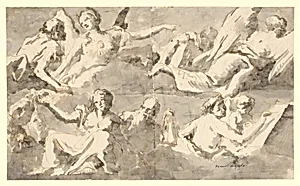
Frieze of Allegorical Figures
after 1770
Medium
Pen and light brown ink, brush and gray wash over black chalk, partly strengthened with a fine pen and dark brown ink
Dimensions
8 11/16 x 14 3/8 in. (22 x 36.5 cm)
Classification
Drawings
Department
Robert Lehman Collection
Museum
Metropolitan Museum of Art, New York, NY
Credit
Robert Lehman Collection, 1975
Accession Number
1975.1.500
Rights
Public Domain
Tags
Art Historical Context
Giovanni Domenico Tiepolo, the gifted son of the renowned Venetian Rococo master Giovanni Battista Tiepolo, created this *Frieze of Allegorical Figures* after 1770, during the later phase of his career. Executed in pen and light brown ink with brush and gray wash over black chalk—and selectively reinforced with fine pen and dark brown ink—this drawing exemplifies the Tiepolo family's virtuosic draftsmanship. Measuring 8 11/16 x 14 3/8 inches, it belongs to the Robert Lehman Collection at The Metropolitan Museum of Art, acquired in 1975. The composition unfolds as a horizontal frieze, a format evoking ancient Roman and Renaissance decorative schemes, populated by male and female allegorical figures in dynamic procession. Tiepolo's fluid, expressive lines and subtle gray washes bring volume and movement to the forms, blending Rococo elegance with emerging Neoclassical poise. Such allegories often symbolized virtues, the arts, or classical ideals, reflecting the Enlightenment-era fascination with moral and intellectual themes. This work highlights Tiepolo's mastery of mixed media, likely a finished presentation drawing or study for frescoes or prints. Produced amid Venice's waning artistic dominance, it captures the enduring vitality of the Tiepolo legacy, inviting viewers to ponder the timeless dance of human symbolism.
About the Artist
Giovanni Domenico Tiepolo · 1727–1804
Giovanni Domenico Tiepolo (1727-1804) was a Venetian painter, printmaker, and draftsman whose career spanned the twilight of the Rococo era. Born on August 30, 1727, in Venice as the eldest son of the celebrated Giovanni Battista Tiepolo, he worked both in his father's shadow and as a significant independent artist who developed a distinctly earthbound and humanistic vision. Domenico's importance...