
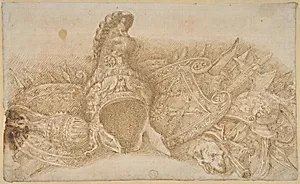
Frieze of Trophies
Medium
Pen and brown ink, brush and brown wash, over leadpoint
Dimensions
8 x 13 5/16 in. (20.3 x 33.8 cm)
Classification
Drawings
Department
Drawings and Prints
Museum
Metropolitan Museum of Art, New York, NY
Credit
Gift of Cornelius Vanderbilt, 1880
Accession Number
80.3.581
Rights
Public Domain
Tags
Art Historical Context
Polidoro da Caravaggio, an Italian Renaissance artist active in the early sixteenth century, created this delicate drawing titled *Frieze of Trophies*. Known for his work alongside Raphael’s circle in Rome, Polidoro specialized in decorative that revived ancient Roman motifs. The sheet presents a horizontal arrangement of trophies—classical symbols of victory featuring armor, weapons, and animal elements—intended to evoke the grandeur of triumphal processions. Executed in pen and brown ink with brush and brown wash over leadpoint, the drawing reveals the artist’s working method. The faint leadpoint underdrawing allowed for precise planning, while the ink and wash added depth and shadow, giving the trophies a sculptural presence. Such studies were often preparatory for fresco friezes that adorned Roman palaces, blending archaeological interest with elegant ornament. Now part of the Metropolitan Museum of Art’s collection thanks to Cornelius Vanderbilt’s 1880 gift, the work highlights the Renaissance passion for classical antiquity and the enduring appeal of these martial emblems as emblems of power and artistic refinement.
About the Artist
Polidoro da Caravaggio · 1492–present
Polidoro Caldara, known as Polidoro da Caravaggio, was born around 1499 in Caravaggio, Lombardy, and emerged as one of the most innovative painters of the early Mannerist period. Arriving in Rome circa 1515 as an untrained laborer hauling plaster for the Vatican Logge decorations, he quickly caught the eye of Raphael's key assistant, Maturino da Firenze. By 1517, Polidoro had joined Raphael's work...