
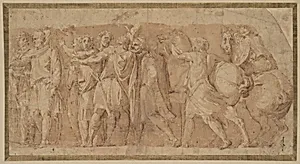
Frieze with Male Figures and Two Horses
mid-16th century
Medium
Pen and brown ink, brown wash.
Dimensions
7 3/4 x 15 in. (19.7 x 38.1 cm)
Classification
Drawings
Department
Robert Lehman Collection
Museum
Metropolitan Museum of Art, New York, NY
Credit
Robert Lehman Collection, 1975
Accession Number
1975.1.407
Rights
Public Domain
Tags
Art Historical Context
Welcome to the Robert Lehman Collection at The Metropolitan Museum of Art, you'll discover *Frieze with Male Figures Two Horses*, a captivating mid-16th-century by Polidoro daaggio. Created with pen and brown ink heightened by brown wash on a modest 7 3/4 x 15-inch sheet, this work evokes the grandeur of ancient Roman processions. Polidoro, a pupil of Raphael and a key figure in Roman Mannerism, was renowned for facade frescoes on buildings like the Palazzo Milesi where he masterfully imitated classical stone reliefs using illusionistic monochrome techniques. This frieze-like composition, bustling with dynamic male figures and rearing horses, reflects Polidoro's deep fascination with antiquity. During the Renaissance, artists like him bridged classical antiquity and the modern era by studying sarcophagi and triumphal friezes, infusing them with energetic, elongated forms typical of Mannerism. The brown wash adds subtle volume and shadow, bringing the scene to life and hinting at its potential as a preparatory study for frescoes or prints. As a rare surviving drawing, it showcases Polidoro's precise linework and his role in popularizing "grosteschi"—ornate, narrative decorations inspired by Rome's ruins. A testament to the era's revival of classical motifs, this piece invites you to imagine ancient warriors thundering across a palace wall.
About the Artist
Polidoro da Caravaggio · 1492–present
Polidoro Caldara, known as Polidoro da Caravaggio, was born around 1499 in Caravaggio, Lombardy, and emerged as one of the most innovative painters of the early Mannerist period. Arriving in Rome circa 1515 as an untrained laborer hauling plaster for the Vatican Logge decorations, he quickly caught the eye of Raphael's key assistant, Maturino da Firenze. By 1517, Polidoro had joined Raphael's work...