
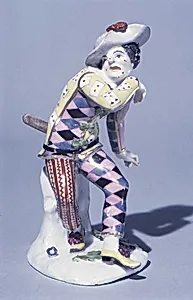
Frightened Harlequin
Medium
Hard-paste porcelain
Dimensions
Height: 6 1/2 in. (16.5 cm)
Classification
Ceramics-Porcelain
Culture
German, Meissen
Department
European Sculpture and Decorative Arts
Museum
Metropolitan Museum of Art, New York, NY
Credit
Gift of Irwin Untermyer, 1964
Accession Number
64.101.74
Rights
Public Domain
Tags
Art Historical Context
Step into the whimsical world of 18th-century European porcelain with *Frightened Harlequin a delightful figurine crafted around 1740 by the renowned Meissen Manufactory collaboration with master modeler Johann Joachim Kändler. Standing just 6½ inches tall, this hard-paste porcelain piece captures a comically startled Harlequin—a mischievous stock character from the Italian Commedia dell'arte theater tradition—frozen in a moment of exaggerated alarm, his wide eyes and dynamic pose evoking playful Rococo exuberance. Meissen, the pioneering German factory near Dresden, revolutionized ceramics in 1710 as Europe's first to produce true hard-paste porcelain, rivaling China's coveted wares with its translucent durability and fine detail. Kändler, Meissen's chief sculptor from 1733, elevated these figurines (known as *aricanele*) into miniature masterpieces, blending intricate modeling, vibrant overglaze enamels, and gilding to depict theatrical scenes for aristocratic tabletops. This *Frightened Harlequin* exemplifies the era's love for lighthearted fantasy amid the opulent courts of Saxony. A gift to the Metropolitan Museum of Art in 1964 from Irwin Untermyer, this gem from the European Sculpture and Decorative Arts collection highlights Meissen's cultural dominance, turning everyday luxury into enduring art that still delights with its lively charm and technical virtuosity.
About the Artist
Meissen Manufactory|Johann Joachim Kändler · 1710–present
The Meissen Manufactory, established on June 6, 1710, by Augustus the Strong, Elector of Saxony and King of Poland, marked the dawn of true hard-paste porcelain production in Europe. Nestled at Albrechtsburg Castle in Meissen near Dresden, the Royal Polish and Electoral Saxon Porcelain Manufactory arose from alchemical experiments begun in 1708 by physicist Ehrenfried Walther von Tschirnhaus and p...