
Friuli Spear
1540/60
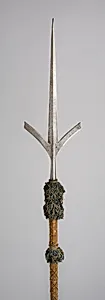
Medium
Steel, wood (pine), velvet, brass nails, tassels, and gilded rosaces
Dimensions
H.: 263.5 cm (103 3/4 in.); Blade and socket: H.: 75.2 cm (29 5/8 in.)
Classification
edged weapon-staff
Department
Applied Arts of Europe
Museum
Art Institute of Chicago
Accession Number
116259
Rights
Public Domain
Art Historical Context
This impressive Friuli Spear, dating to 1540–60, stands as a finely crafted example of Renaissance-era European weaponry in the Art Institute of Chicago’s Applied Arts of Europe collection. Measuring over 2.6 meters in, it consists of a long pine-wood shaft fitted with a steel blade and socket, further embellished with velvet wrapping, brass nails, tassels, and gilded rosaces. Produced by an unknown artisan, the piece originates from or is associated with the Friuli region of northeastern Italy, a area known for skilled metalworkers and woodworkers during a period of frequent military activity. The luxurious decorative elements—velvet, tassels, and gold-finished ornaments—indicate that this staff weapon likely served ceremonial, parade, or status purposes in addition to any battlefield role. In 16th-century Europe, such polearms combined practical edged-weapon design with artistic refinement, reflecting the era’s fusion of martial needs and courtly display. The contrast between the functional steel blade and the ornate shaft highlights the high level of craftsmanship typical of Italian applied arts at the time. Today the spear offers visitors a tangible connection to Renaissance material culture, illustrating how even weapons could embody both utility and beauty through mixed-media techniques of metalworking, woodworking, and textile application. Its presence in a museum setting underscores the enduring artistic value of objects once used in daily life and conflict.
About the Artist
Unknown
The artist designated as "Unknown" in our virtual museum's collection exemplifies a poignant chapter in art history: creators whose identities have faded into obscurity despite the enduring power of their work. With only one known artwork attributed to them in our holdings, this figure represents countless anonymous hands that shaped visual culture across centuries. Museums worldwide, including th...