
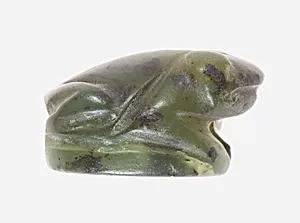
Frog amulet
Unknown Artist
ca. 1295–1070 B.C.
Medium
Serpentinite
Dimensions
H. 0.9 × L. 1.5 × W. 1.2 cm (3/8 × 9/16 × 1/2 in.)
Classification
Amulet, Frog
Period
New Kingdom, Ramesside
Department
Egyptian Art
Museum
Metropolitan Museum of Art, New York, NY
Credit
Theodore M. Davis Collection, Bequest of Theodore M. Davis, 1915
Accession Number
30.8.861
Rights
Public Domain
Tags
Art Historical Context
This diminutive frog amulet, from serpentinite—a dense, green stone prized in ancient Egypt for its vibrant hue evoking life's renewal—dates to the New Kingdom's Ramesside period (ca. 1295–1070 B.C.), during Dynasties 19–20. Measuring just 0.9 cm high, it exemplifies the exquisite miniaturist craft of Egyptian jewelers, who shaped protective talismans small enough to wear as jewelry or place in tombs. Such amulets were everyday guardians, invoking magical powers through their form and material. Frogs held profound cultural significance in ancient Egypt, symbolizing fertility, rebirth, and the Nile's life-giving floods, as tadpoles emerged from muddy waters each year. Linked to the goddess Heqet, who oversaw childbirth and resurrection, this frog likely served as a personal charm for protection, prosperity, or safe passage to the afterlife. Crafted with precise carving that captures the amphibian's rounded form and alert posture, it reflects the Ramesside era's mastery of hard-stone sculpture amid Egypt's imperial height under pharaohs like Ramesses II. Now in the Metropolitan Museum of Art, part of the Theodore M. Davis Collection (bequeathed 1915), this artifact offers a window into the intimate spirituality of ordinary Egyptians, blending artistry with profound belief in the natural world's divine forces.