
Wedjat Eye Amulet
Unknown Artist
ca. 1390–1352 B.C.
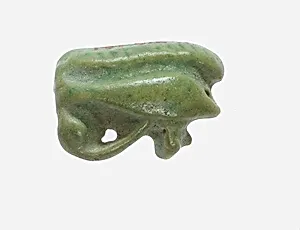
Medium
Faience
Dimensions
L. 1.3 cm (1/2 in)
Classification
Amulet, Wedjat eye, Maat
Period
New Kingdom
Department
Egyptian Art
Museum
Metropolitan Museum of Art, New York, NY
Credit
Rogers Fund, 1911
Accession Number
11.215.141
Rights
Public Domain
Art Historical Context
Behold the Wedjat Eye Am, a tiny yet powerful talisman from ancient Egypt's Kingdom, dating to around 1390–1352 B.C. during Dynasty 18—the golden age of pharaohs Amenhotep III and Tutankham. Crafted from faience, a vibrant glazed ceramic favored by Egyptian artisans for its brilliant blue-green hues mimicking precious stones, this 1.3 cm amulet exemplifies the era's mastery of small-scale luxury goods. Faience's durability and luster made it ideal for everyday protective charms, blending artistry with accessibility. The Wedjat, or Eye of Horus, symbolizes wholeness, protection, and royal power, drawing from the myth where Horus's eye was torn out by Seth and magically restored by Thoth. Worn as jewelry, placed in tombs, or carried for safeguarding against evil, such amulets were ubiquitous in daily life and the afterlife. This piece, acquired through the Rogers Fund in 1911, highlights the Metropolitan Museum of Art's rich Egyptian collection, offering a glimpse into the spiritual worldview of a civilization obsessed with eternity. Though anonymous, its precise detailing reveals sophisticated techniques like mold-casting and glazing, underscoring Egypt's innovative craft traditions that influenced millennia of art. A perfect pocket-sized guardian from the Nile Valley's splendor!