
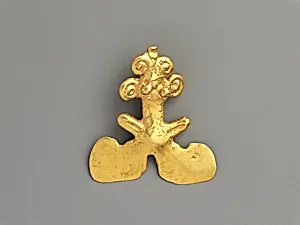
Frog pendant
Unknown Artist
11th–16th century
Medium
Gold
Dimensions
L. 1 1/2 in. (3.8 cm)
Classification
Metal-Ornaments
Culture
Chiriqui
Department
Arts of Africa, Oceania, and the Americas
Museum
Metropolitan Museum of Art, New York, NY
Credit
Edward C. Moore Collection, Bequest of Edward C. Moore, 1891
Accession Number
91.1.1161
Rights
Public Domain
Tags
Art Historical Context
This exquisite Frog Pendant, crafted by an unknown Chiriqui artist between the 11th and 16th centuries, exemplifies the masterful goldworking traditions of pre-Columbian Panama. Measuring just 1 1/2 inches (3.8 cm) in, this delicate ornament from the Chiriqui culture—indigenous to the region now encompassing western Panama—likely served as personal adornment, perhaps worn as jewelry or a ritual item. Its small scale belies the sophistication of its design, capturing the frog's dynamic form in shimmering gold, a material revered for its rarity and symbolic ties to the sun, wealth, and divine power. Gold held profound cultural significance for the Chiriqui people, who were renowned metalworkers in the Intermediate Area of the Americas. They expertly hammered and cast gold into intricate animal motifs, with frogs appearing frequently—possibly evoking themes of fertility, water, and transformation in their cosmology, given the amphibian's life cycle. This pendant reflects broader artistic practices in the Arts of Africa, Oceania, and the Americas, where such ornaments bridged the everyday and the spiritual. Now housed in the Metropolitan Museum of Art as part of the Edward C. Moore Collection (bequest of 1891), it offers a glimpse into a vibrant society just before European contact. Visitors, marvel at how this tiny treasure preserves the Chiriqui's enduring legacy of artistry and belief.