
Frog Vessel
Unknown Artist
2nd century BCE–3rd century CE
Medium
Ceramic, pigment (?)
Dimensions
H. 5 3/16 x W. 4 3/4 x D. 6 7/8 in. (13.3 x 12.1 x 17.4 cm)
Classification
Ceramics-Containers
Culture
Colima
Department
Arts of Africa, Oceania, and the Americas
Museum
Metropolitan Museum of Art, New York, NY
Credit
The Michael C. Rockefeller Memorial Collection, Bequest of Nelson A. Rockefeller, 1979
Accession Number
1979.206.332
Rights
Public Domain
Tags
Art Historical Context
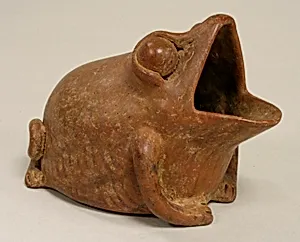
Step into the ancient world of West Mexico with the *Frog Vessel*, a charming ceramic container from the Colima culture, crafted between the 2nd century BCE and 3rd century CE. Housed in the Metropolitan Museum of Art's Department of Arts of Africa, Oceania, and the Americas, this petite artwork—standing just 5 3/16 inches tall, 4 3/4 inches wide, and 6 7/8 inches deep—showcases the Colima people's skill in shaping everyday clay into lively animal forms. Formed from ceramic with traces of pigment (?), the vessel's frog-like body highlights the naturalistic modeling techniques of pre-Columbian potters. Colima ceramics from this era often featured bold, zoomorphic designs, blending utility as a container with artistic expression. Frogs, a recurring motif, may evoke the natural world and seasonal cycles central to these communities. Generously bequeathed through The Michael C. Rockefeller Memorial Collection in 1979, this piece offers a tangible link to Colima's vibrant traditions. Its whimsical yet sophisticated form reminds us how ancient artisans transformed simple materials into enduring symbols of culture.