
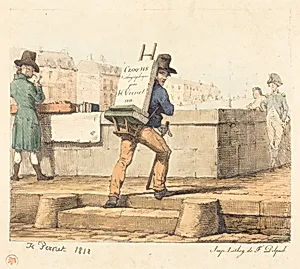
Frontispiece for the portfolio "Croquis Lithographiques par H. Vernet"
1818
Medium
lithograph with hand coloring on wove paper
Dimensions
sheet: 26.7 × 36 cm (10 1/2 × 14 3/16 in.)
Classification
Department
CG-E
Museum
National Gallery of Art, Washington, D.C.
Credit
Rosenwald Collection
Accession Number
1964.8.1705
Rights
Public Domain
Art Historical Context
Step into the dynamic world of early 19th-century French with Horace Vernet's *Frontispiece for the portfolio "Croquis Lithographiques par H Vernet"* (1818). As a leading Romantic artist and lithographer, Vernet was renowned for his vivid depictions of military life, horses, and Orientalist themes, capturing the energy of post-Napoleonic Europe. This frontispiece as an inviting title page for his portfolio of lithographic sketches, his skill in translating spontaneous drawings into reproducible prints—a revolutionary format for artists seeking broader audiences. Crafted as a lithograph with delicate hand coloring on wove paper (26.7 × 36 cm), the work highlights lithography's innovative "greasy crayon" technique, invented just two decades earlier. This allowed Vernet to mimic the fluidity of his sketchbook croquis directly on stone, with hand-applied colors adding lifelike vibrancy. Its presence in the National Gallery of Art's Rosenwald Collection underscores its role in democratizing art: affordable prints brought Vernet's dramatic style to collectors and enthusiasts alike. A testament to lithography's rapid rise, this piece bridges fine art and mass reproduction, inviting us to appreciate Vernet's pioneering spirit in an era of artistic experimentation.
About the Artist
Horace Vernet · 1789–1863
**Horace Vernet** (full name Émile Jean-Horace Vernet) was a leading French painter of the nineteenth century, renowned for his dynamic battle scenes, portraits, and Orientalist subjects. Born on 30 June 1789 in Paris at the Louvre during the French Revolution, he came from a distinguished artistic dynasty. He was the son of the equestrian and military painter Carle Vernet and the grandson of the ...