
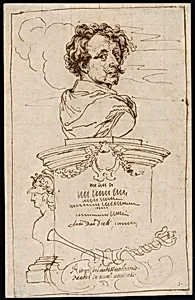
Frontispiece from the "Iconography"
late 17th century
Medium
Pen and iron gall ink on cream laid paper
Dimensions
29.9 × 19 cm (11 13/16 × 7 1/2 in.)
Classification
drawings (visual works)
Department
Prints and Drawings
Museum
Art Institute of Chicago
Accession Number
228381
Rights
Public Domain
Art Historical Context
Step into the Prints and Drawings department at the Art Institute of Chicago to admire Anthony van Dyck's *ispiece from the "Iconography"*, a delicate drawing from the late 17th century Rendered in pen and iron gall ink on cream laid (29.9 × 19 cm), this intimate work measures just 11 13/16 × 7 1/2 inches, capturing the finesse of Baroque draftsmanship in a compact format. Van Dyck, the Flemish master of portraiture and a key figure in the Baroque movement, created his *Iconography* (or *Icones Principum*) as a groundbreaking series of engraved portraits depicting Europe's eminent artists, scholars, and rulers from the early 17th century. This frontispiece likely served as an elegant introductory page for one of the later editions, perpetuating Van Dyck's vision of celebrity and legacy through print culture. The project's innovation lay in making high-society likenesses widely accessible, influencing the rise of reproductive prints. Crafted with iron gall ink—a traditional medium made from oak galls, iron salts, and gum arabic, prized for its rich brown tones but notoriously corrosive to paper over time—this drawing exemplifies old master techniques. Its precise lines and subtle shading highlight Van Dyck's skill in conveying grandeur and personality, offering visitors a tactile glimpse into 17th-century artistic collaboration between drawing and engraving.
About the Artist
Anthony van Dyck · 1599–1641
Sir Anthony van Dyck (1599-1641) was a Flemish Baroque artist who revolutionized portrait painting and became the most influential court painter in 17th-century England. Born in Antwerp as the seventh of twelve children to a prosperous silk merchant, van Dyck displayed extraordinary artistic talent from childhood. He trained under Hendrick van Balen before joining Peter Paul Rubens's workshop as a...