
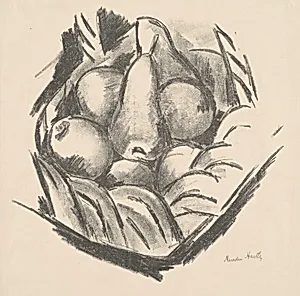
Fruit Basket
1923
Medium
lithograph in black on wove paper
Dimensions
image (irregular): 34.77 × 34.29 cm (13 11/16 × 13 1/2 in.) sheet: 39.37 × 38.74 cm (15 1/2 × 15 1/4 in.)
Classification
Department
CG-W
Museum
National Gallery of Art, Washington, D.C.
Credit
Corcoran Collection (Museum Purchase, Mary E. Maxwell Fund)
Accession Number
2015.19.1021
Rights
Public Domain
Art Historical Context
Marsden Hartley's *Fruit Basket* (1923) is a striking lithograph in black ink on smooth wove paper, capturing a humble still life with modernist flair. Measuring nearly 14 inches square in its irregular image area, this print exemplifies Hartley's exploration of everyday subjects during the early 1920s, a period when the American artist had returned from Europe and embraced bolder, simplified forms influenced by his modernist roots. As part of the Corcoran Collection at the National Gallery of Art—acquired through the Mary E. Maxwell Fund—it highlights the era's growing interest in accessible printmaking. Lithography, Hartley's chosen medium here, allowed artists to translate drawn lines directly onto stone for multiple impressions, bridging fine art and reproduction. The technique's greasy crayon yields rich, velvety blacks against the paper's subtle texture, emphasizing volume and shadow in the overflowing basket of fruit. This work nods to the still-life tradition—from Dutch masters to Cézanne—while infusing it with Hartley's distinctive intensity, honed through his associations with Expressionism and the avant-garde. Visitors will appreciate how *Fruit Basket* distills abundance into elegant abstraction, inviting reflection on nature's forms amid the interwar cultural shifts. A testament to Hartley's versatility, it remains a gem in print collections, perfect for savoring up close.
About the Artist
Marsden Hartley · 1877–1943
Marsden Hartley (1877–1943) was one of the most significant and searching figures of American modernism, an artist whose restless travels and personal intensity drove him to synthesize European avant-garde currents with a deeply American sensibility rooted in landscape, loss, and spiritual longing. Born in Lewiston, Maine, he studied at the Cleveland School of Art and later at the National Academy...